
Article written by Sydney Lang
Illustration by Alexandra Enache
This piece was originally published in ‘Chimera’, Bossy’s 2022 print edition.
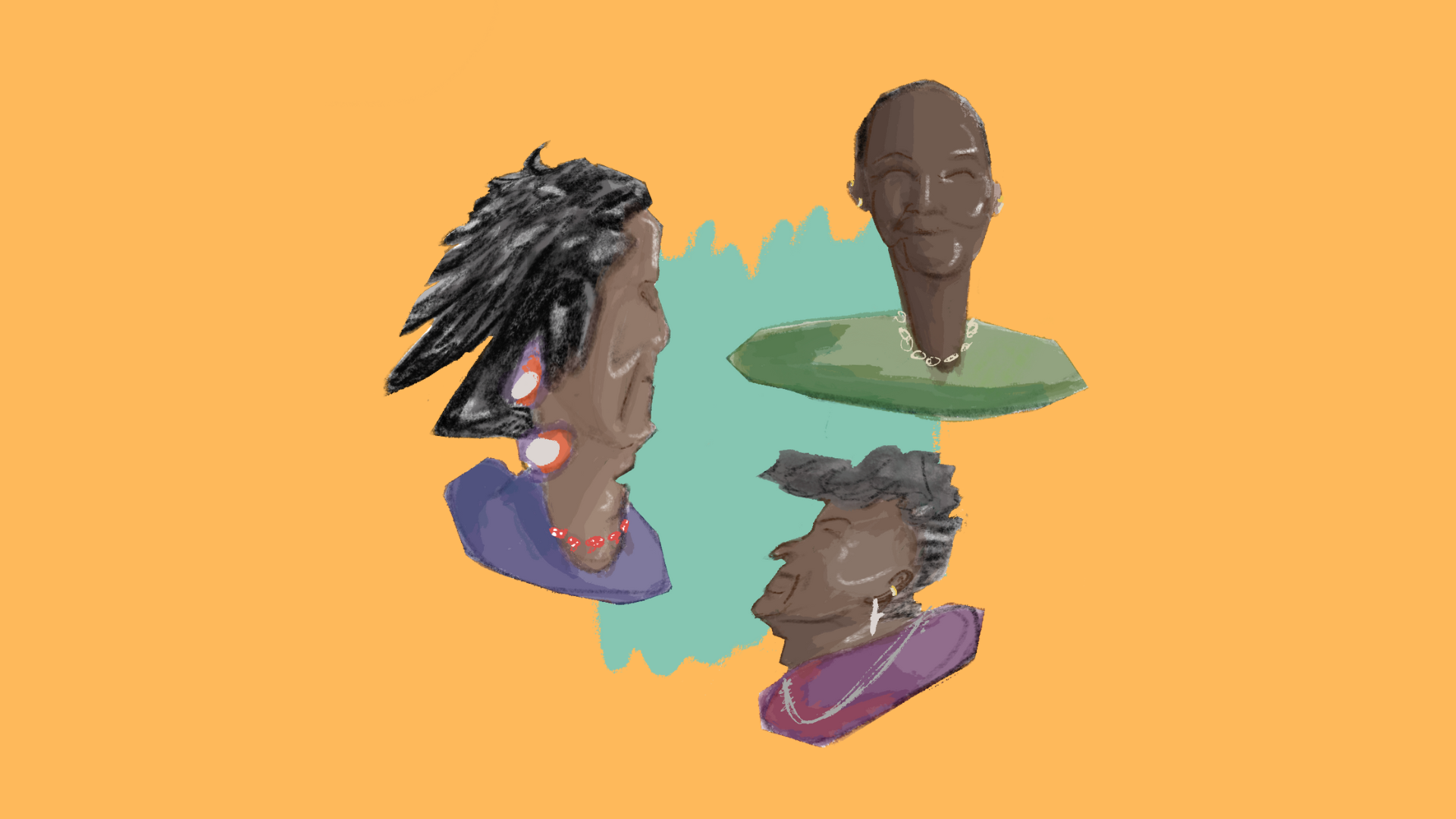
Women over 50 are not past their prime, but the men who try to write them might be.
When I look to the older women in my life, it is most often with a deep admiration. I have a very funny and very smart mother who does as she pleases and is never spoken over: she is beautiful, and anything but frail. Yet, when I look at the older women in the film and television from my childhood, I see an uncomfortably different picture. Growing up in an environment where I saw not a single openly queer person within my family or friendship circles, trying to envision what my future would look like was strange. When queerness was represented in film and television, it was most often by either camp gay men, or angry, masculine queer women. For most of my life, I failed to accept that I was gay, and when I finally did, I had still never seen an older queer woman on screen who reflected how I felt. This had a profound effect on me; seeing no examples of a happy future for people you relate to, it can be difficult to embrace, let alone accept your identity. The industry’s lack of nuanced representation is not limited to queerness, but applies to women in general who, especially once reaching a certain age, find the extent of their roles on screen so narrow and predictable that their realities are barely recognisable.
A 2019 report titled “Frail, Frumpy and Forgotten” found that only 25.3% of women characters on screen were over the age of 50, and not one of those women held a lead role. When these characters were present, they were often depicted as sexless housewives whose character development was consistently bound to the actions of their children or husbands. Older women often went quite literally unseen except within the domestic confines and when standing beside (or more often behind) a man. Not once were they given a role resembling the lives of older women I see in my own life.
If you’ve ever watched the movie Muriel’s Wedding, you would remember Muriel’s mother Betty Heslop. In each scene she appears pitiful, a naïve drag in her failing family. She is a perfect example
of the role older women are confined to: the trope of the frail and frumpy aged woman—despite her actress being only 43 in the film. Often stood behind her husband, her character is ignored, undesirable, compliant, and sad. The film portrays this mother of five as an unstable woman, eventually culminating in her tragic suicide
at the end of the film, which, although eliciting momentary sadness from her family, is moved on from concerningly fast. In her portrayal ,
Betty reminds us of the cultural misogyny engrained not only within media, but within our households. The social and economic outcome of many women is dependent on the authority of her husband, whose labour is revered, upheld, and importantly, paid. Betty’s
reduction to petty theft and apparent fiscal incompetency is no fault of her own, but the result of an unkind and ungrateful husband’s dictations. Betty exists as a character painfully representative of the invisible and uninteresting roles delegated to ageing women in film and in society.
On the occasion that a woman over 50 on screen is not tied relentlessly to her husband or children, she is almost certainly longing to be. The persistent idea of women feeling unfulfilled without marriage or children is starkly different from the on-screen portrayal of older single men, whose mature age in film does not reduce their sexuality, but rather grants them a wealth of sexual knowledge. Older men are silver foxes, often wealthy and successful, smooth talking and far from past their prime. These contrasting images—likely the white male director’s perception—are evidence of a trope deeply engrained in society painting he as the subject, and all others as his backdrop. My mother has raised six children—she adopted the sixth—and throughout her life she has welcomed countless more people into our home. She often cooked for
nine people every night, she always had a story to tell, and she has never once stopped making us laugh. My mother is exceptional, but she is not the exception—the stories being told on our screens are simply failing to appreciate the work of women not defined by these
stereotypes.
Beyond the obvious problems of such depictions, the roles of older women in film and television also suffer deeply from a lack of diversity. Not just diversity of characterisation, but of intersection. As the conversation surrounding representation in media continues to shift in a somewhat positive direction, the industry’s continued domination by white men means it is still failing to be quiet for the voices that these men deem unattractive or uninteresting. Not only is the film and television industry stuck with this rotting idea of older women being frumpy, sexless mothers without achievements beyond the family, but they’re also all too often white, cisgender, and heterosexual. This isn’t to say that today’s industry is not shifting
the narrative; nevertheless, it still appears to be burdened by an inability to tell a diverse story of the ageing woman’s experience. The heteronormative whitewashing of film and television has always been an overwhelming flaw in the film industry. There exists a litany of tropes assigned to older women of colour; racial stereotypes pervasively restrict the roles given to women over 50. The racist characterisation of older Asian women as stern and restrictive, the “sassy” role assigned to older Black women, among many others, are all tropes that designate women to roles perpetuating misunderstanding.
In this era of screen, so much of our understanding about lives outside our own has come from television—from what we watched after school to what we now binge on Netflix. When these tropes are employed, not only are they the product of lazy writing, but they also reflect harmful assumptions. While tropes shift and representations seem to change, many still find roots in harmful places. Racial tropes in the media often play into deeply harmful perpetuations of fetishisation and sexualisation, originating in racist rhetoric surrounding BIPOC women and views that were formed and have been reinforced by white men for generations. One of the most glaring examples is the perpetuation of the “mammy” stereotype of older Black women, a trope rooted in slavery and the Jim Crow era. The “mammy” role refers to the depiction of Black women in America fulfilling the role of caregivers, often nannying the children of white, affluent families. Whilst the role of the caregiver has evolved, it has not disappeared; it is currently resurfacing in the form of the therapist figure, usually for white and often wealthy characters. With examples in Broad City as well as Grace and Frankie—both shows centring white women—the trope fails to give depth to these women’s roles beyond their relationship with a white character. Not only this, but it perpetuates the assumption that Black women owe others a degree of niceness or hospitality, and validates the history of white feminism’s dismissive treatment of women of colour. In a 2019 article for The Conversation, professor Cheryl Thompson astutely notes that “this [trope] creates a racial dynamic where people of colour are required to maintain white comfort to survive.” Not only do these one-dimensional representations stifle the futures women see for themselves, but they also dramatically influence society’s views toward the women in our lives, often with dangerous results.
The way the film industry still struggles to give nuance or character development to the roles of older women is embarrassing. However, queer and BIPOC representation in the media is gradually expanding, and television shows such as Euphoria and Sex Education are paving the way for mainstream media to expand its scope. Despite its flaws, Grace and Frankie manages to depict older women in a light more reflective of the truth—written by the actors who play the titular characters, it follows a friendship between two women and their development of sex toys for older women, acknowledging their sexuality as something that is changing but not disappearing. More recently, A League of Their Own stars a largely queer cast, and focuses on the anxieties of queerness during a less-accepting 1940s America and the “All-American” women’s baseball league. The series both portrays queerness honestly and delves into the deeper challenges felt by a queer Black woman. Maxine—whose experiences are not sugar-coated to appear similar to her white cast members’, nor ignored—is written with true depth and acknowledgement of intersection; the show expresses Maxine’s own reckoning with sexuality and the struggles of her transgender uncle, Bert. Throughout the show, we engage with an array of genuine queer experiences, young and old; whilst each character is faced with real challenges, none are reduced to their struggles or stereotypes.
More and more, we are hearing the voices of women who are not “past their prime” and are not overlooked, but who have lived long enough to see through the stupidity of those who think it their place to tell a story that isn’t their own. While there is always more to be done, it is an honest relief to see film and television slowly presenting the voices it has so long kept quiet. Representation in the media is deeply important—the repetition of language and imagery solidifies ideas into culture, and since the film and television industry is ubiquitous in our lives, it is instrumentally influential. With realistic and diverse portrayals on screen, opportunities widen, and cultural expectations—if not totally extinguished—are broadened for the better.



Leave a Reply