
Article written by Thilara De Mel
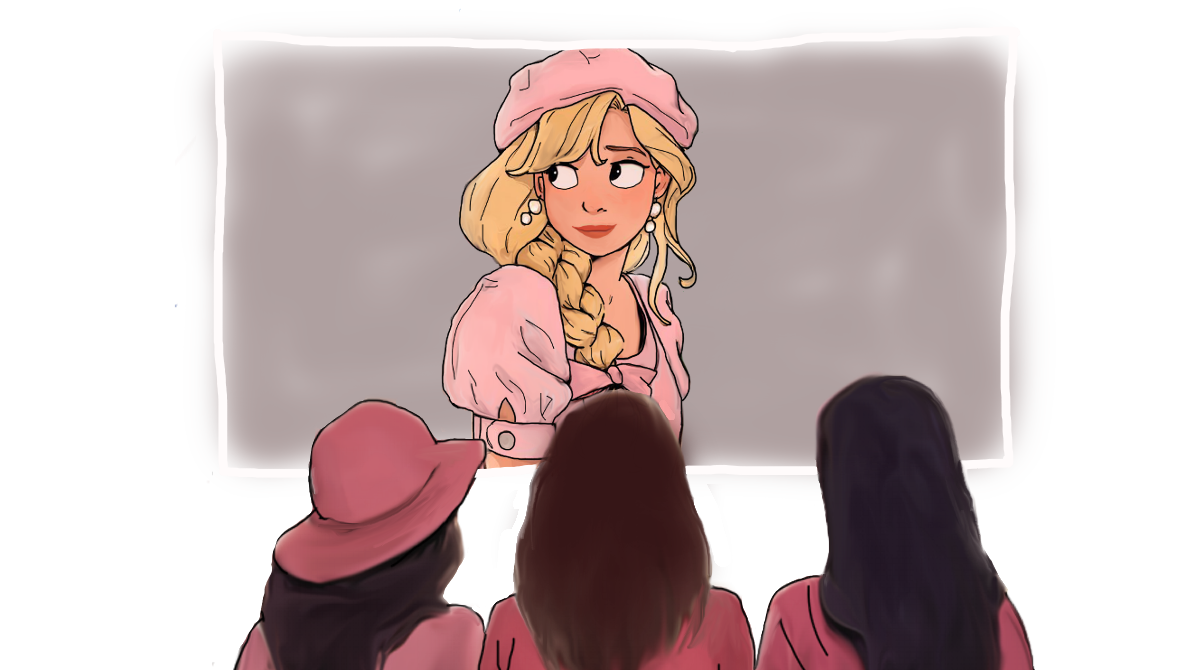
Illustration by Suhani Kapadia
This piece was originally published in ‘Vestige,’ Bossy’s 2023 print publication.
Pantone 219C, sparkles and a cliche message on girl power. That’s what I was expecting from Barbie, but boy was I pleasantly proven wrong.
With the help of a star-studded cast including Margot Robbie (Barbie), Ryan Gosling (Ken) and Dame Helen Mirren (Narrator), and an impressive set and costume design team, Greta Gerwig’s latest directorial masterpiece shines a glittery light on the realities of being a woman.
At first glance, the ideas of Barbie may appear to be ‘surface-level’—yet concealed behind the hilarity and brilliant colours, are evident truths that connect with every woman watching. In fact, Gerwig included a beautiful collection of deeply thought-provoking scenes in her film.
In the out-of-the-box trailer which acted as the opening scene of Barbie, Gerwig parodies the opening scene of Stanley Kubrick’s iconic 1968 film 2001: A Space Odyssey. Whilst Kubrick’s intention for his opening scene was to portray the Dawn of Man and the transition into cognitive development, Gerwig flips the idea to represent the Dawn of Woman. Her twist on 2001: A Space Odyssey satirises society’s view on women and highlights how dolls have influenced the way girls are perceived in a patriarchal society.
Cut to the next scene of the film when the audience is transported to the sparkly, colourful world of Barbieland where all the Barbies (and Kens) live in a matriarchal society. In Barbieland, the Barbies hold all the important job positions, including the President of Barbieland (Issa Rae), and are self-confident and independent dolls. However, things start to go astray for Barbie as thoughts of death and skin imperfections begin to arise. After talking to Weird Barbie (Kate McKinnon), Barbie ventures into the ‘real world’ to find the child playing with her. Ken chooses to follow her on her journey as he only feels ‘Kenough’ when he is with Barbie, despite her constantly pushing him away.
When Barbie and Ken step into the real world, their perspectives on society are turned on their heads. It may have been overdramatised and hidden behind fluro colours and humour, but Barbie’s experience was something every woman immediately resonated with:
“I feel conscious of myself”
Barbie’s confusion and inability to label the emotions she experienced mirrors that of every little girl transitioning from girlhood to adolescence. Barbie’s once confident and innocent spirit is tarnished by the constant feeling of self-awareness—that for the first time—men were looking at her, but not seeing HER. They were only seeing her body.
Whilst Barbie grapples with the harsh realities of being a woman in the real-world, Ken roams Los Angeles having just learnt about the patriarchy and, for the first time, feels appreciated and accepted. When he returns to Barbieland, he convinces the other Kens to take charge, and the Barbies are indoctrinated into roles like housewives and “long-term, long-distance, low-commitment casual girlfriends.”
Once Barbie finds Gloria (America Ferrera) and her daughter, and discovers that Gloria is the reason why she was malfunctioning, the three of them return to Barbieland, only to find that Barbieland has turned into Kendom. Shocked at how drastically everything has changed, Barbie tries to convince the other Barbies and Kens to return to the way it was but it doesn’t take long for Barbie to start feeling like nothing is working and loses all confidence in herself.
As I sat in the cinema, watching the scene that followed, I was reminded of why Greta Gerwig is one of the most marvellous directors, with her original film Lady Bird and adaptation of Little Women being some of my favourite creations of all time. Whether it’s as an actress or a director, Greta Gerwig always delivers heart-wrenching monologues on the female experience, and she did not disappoint with Gloria’s speech to Barbie:
“I’m just so tired of watching myself and every single other woman tie herself into knots so that people will like us. And if all of that is also true for a doll just representing women, then I don’t even know.”
Although having the titular character deliver the speech may have been a more obvious choice, Gerwig’s choice to have Gloria deliver the monologue was the perfect decision. Gloria was a real-world person of colour who understood the realities of being a woman. Her experience with her stereotypical Barbie highlighted the intersection of shared experiences all women have regardless of race and religious backgrounds. Gerwig’s decision to allow America Ferrera to deliver the speech as it was, without putting any humorous spin on it, made the monologue intensely more inspiring to all of the women watching, as it allowed her to truly articulate how much pressure there is to never to put a foot wrong.
Barbie allows women of all ages to relive their childhood memories by incorporating different Barbies from various eras, even including those that were considered problematic or discontinued. However, by infusing a light-hearted film with powerful truths, Greta Gerwig crafts a poignant love letter to girlhood.


Leave a Reply