

Article written by Heyma Nahar
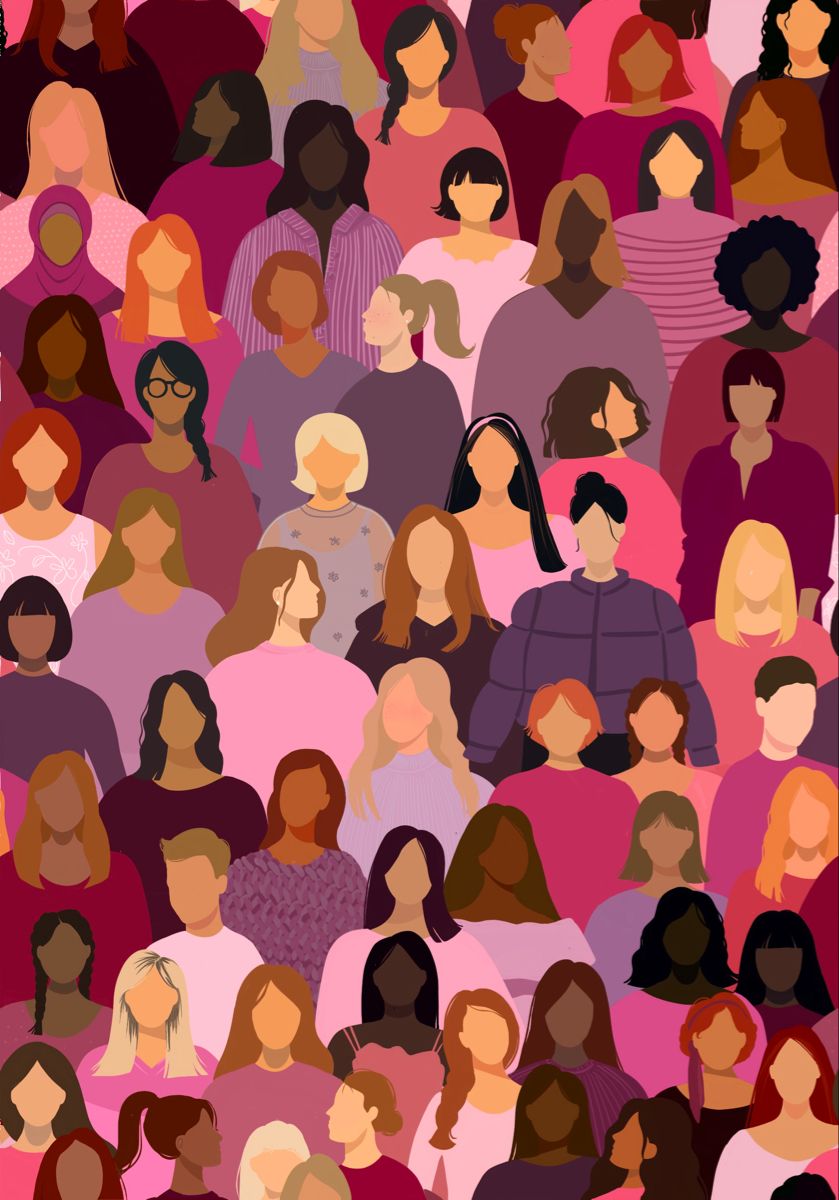
Illustration by Hengjia Liu
This piece was originally published in ‘Memento Mori’, Bossy’s 2021 print edition.
CW: Discussion of murder, sexual assault, racial violence, domestic violence, and missing persons.
About a year ago, I was introduced to my now-favourite pastime: listening to real-life stories of horrendous crimes that invoke the most powerful of emotions—fear. At the start, I listened to murder podcasts as a way to relax—weird, I know. But I fell in love with the enthusiasm and passion with which podcast hosts deliver their content, and I know many others feel the same towards this seemingly unconventional hobby. For me, it was a way to escape the pressures of my high school routine and allowed me to delve into a different world; one which had nothing to do with me or my life.
This was before I stumbled upon RedHanded, a true crime podcast hosted by two British women who bring an intersectional feminist spin to what is traditionally a very white, cisgender, and male-dominated sphere of entertainment. Suruthi Bala and Hannah Maguire showed me that true crime does affect me after all, because women and girls who look like me are often victims of very specific, racialised, and gendered crimes.
Growing up as a second-generation immigrant, a brown girl in a very white neighbourhood, the differences between me and my peers were made clear to me as a young child. I was fully aware that my skin was darker than my friends, and I was conscious of the fact that people who looked like me were often treated badly by people who didn’t look like me.
But that was the extent of my knowledge.
I had yet to discover the nuances in how people’s identities—their race, culture, gender, sexuality, age, socioeconomic status, and disabilities—affected their susceptibility to becoming victims of violent crime.
While studying Society and Culture, I researched the effect of white feminist media on the social exclusion of women of colour, and ultimately found that BIPOC women and members of the LGBTQIA+ community are often the groups in society most vulnerable to social exclusion and violence. I also learnt about the overwhelming effect that the media has on the perpetuation of white feminism; that is, how white feminism in practice is greatly influenced by media that purports itself as ‘feminist’ but neglects to take an intersectional stance, and thus ignores the compounded effects of things like race and sexuality on experiences of discrimination.
This is where I see one of the main issues within the discussion of ethics in true crime media: whose stories are being told? And further, whose stories are we silencing? In this sense, is true crime too problematic to be ethical?
We, as a society, have an uncanny—but completely explainable, and even natural—obsession with stories of horror and violence. Psychologists agree that our ‘human nature’ interest in true crime and serial killers stems from our need to be able to safely explore darker and more sinister environments and incidents. In an evolutionary sense, these stories seem to provide us, as potential victims, the ability to both understand the motives of killers and learn how to get out of dangerous situations. But that brings us to another big question to unpack: why is it largely white women who are so obsessed with true crime?
This white, female demographic of true crime fans is plausible when you consider that many of the most famous classic true crime stories feature white women as victims. Ted Bundy, BTK, the Golden State Killer, Fred and Rose West… do any of them sound familiar? These serial killers are household names, and most—if not all—of their victims were white women. Rachel Monroe, a journalist who specialises in crime, speaks of ‘missing white woman syndrome’: the term used to describe Western media’s disproportionate focus on middle-class white women who disappear or are victims of violent crimes, compared to BIPOC women; members of the LGBTQIA+ community; and women of lower socioeconomic statuses. Does the name Samuel Little ring any bells with you? Little hardly became an enduring household name upon his most recent arrest in 2012—at least, not to the extent of Bundy or BTK—despite having been linked to the largest number of proven cases for any serial killer in the history of the United States. Notably, the majority of his 60 victims were Black women.
You may be familiar with some of the true crime podcasts and films that have become extremely popular in recent years: Serial, My Favourite Murder, Morbid,and True Crime Obsessed are some podcasts that fans tend to name as their favourites. American Murder (Chris Watts) and Extremely Wicked, Shockingly Evil and Vile (Ted Bundy) are some of the most-watched Netflix true crime movies. Most people have heard of Shanann Watts and Lynda Ann Healy. We know Sarah Everard. Most true crime fans have heard of Reeva Steenkamp, and rightly so.
But where is the coverage on Mya Hall, for example? How much do we know about the attacks on Black transgender women? Mya Hall was a Black transgender sex worker who was killed in Baltimore in a gendered and racialised attack in 2015, but much of the media attention around her murder consisted of transphobic allegations which targeted Hall’s character and actions, rather than amplifying the need for greater public awareness about how Black transgender women find themselves at such great risk of violence. Breonna Taylor and Michelle Cusseax’s murders were not covered nearly as thoroughly as the police killings of Eric Garner and George Floyd: the difference between George Floyd’s and Breonna Taylor’s GoFundMe donations by the public were stark, with the former being at almost $14 million and the latter at $6.8 million. Comparing the two here is not to imply that the public attention garnered by the media that resulted in such a large donation for George Floyd’s family was unwarranted—it is simply to try and bridge this gender gap. Why aren’t we talking about how anti-Black violence is experienced in gendered ways?
Similarly, the overrepresentation of Indigenous women and girls within the missing and murdered population in North America and Canada obtains nowhere near the appropriate amount of public awareness. The reality that Indigenous Australian women and girls are 12 times more likely to be victims of sexual assault than non-Indigenous women is not at all something that is highlighted in true crime consciousness. The fact that 41-60 per cent of Asian and Pacific Islander women have reported intimate partner violence (physical and/or sexual) has been egregiously silenced in comparison to domestic violence stories that feature white, middle-class victims.
It is clear there is a vast disparity in whose stories are being told and whose are left behind. By making the repeated choice to address only one kind of story in mainstream media, we are withholding justice from women of colour, as well as many more groups in society who are disenfranchised by the overwhelming whiteness that characterises true crime narratives. We have a long way to go before true crime can become truly intersectional.
Still, issues of intersectionality—such as gendered manifestations of anti-Black violence—have ample opportunity to be explored through true crime media, despite only few content creators choosing to take up the responsibility of bringing an intersectional social commentary into their dialogue. Two of RedHanded’s six Black Lives Matter episodes, for example, address the way in which police violence is specifically targeted towards Black women. More broadly, the podcast deals with issues of socioeconomics, race, gender, sexuality, and culture in a multidimensional light with the utmost compassion and candour, as opposed to many mainstream true crime podcasts which can be prone to tone deafness and insensitivity. Serial, for instance—one of the most popular true crime podcasts—has been critiqued for stereotyping people of colour and upholding systems of white privilege through its one-dimensional take on systemic issues. While I think it is fair to say that there isn’t currently a great deal of ethical true crime media to speak of in the public eye, RedHanded has certainly proven a good place to start as we look forward, to the future of true crime.
Do I think it is unethical to call yourself a true crime media fan? Not necessarily. Not when the stories you listen to encourage empathy, compassion, and thought about some of the most complex sociopolitical and cultural issues that plague the world today. Not when they can do so much for criminological education and teaching ordinary people about the ways in which people’s identities and environments can make them more vulnerable to violent crimes—because let’s face it, many crimes are inherently political. Separating wider social issues from individual instances of crimes is futile, because we are inextricably linked to the societies we live in.
Broadly, I would encourage lovers of true crime to seek out content creators who dive into the social and political nuances that characterise instances of violent crimes, and are willing to discuss why certain groups in society are vulnerable. It is true that much true crime content is unethical for the reasons I have mentioned above, but I believe it is also true that with an uprise in the intersectionality movement, and with more and more content creators deliberately seeking to educate themselves and others about racial nuances, we can look forward to more ethical true crime entertainment in the future.
True crime can be ethical, but only if we put in the work. If creators assume responsibility in uplifting disenfranchised voices and ensuring their content output is intersectional, I believe that true crime media is capable of evolving into the tool we have been searching for in beginning a frank discussion of intersectionality and how it relates to victims of crime.



Leave a Reply