
Article written by Sirria Li
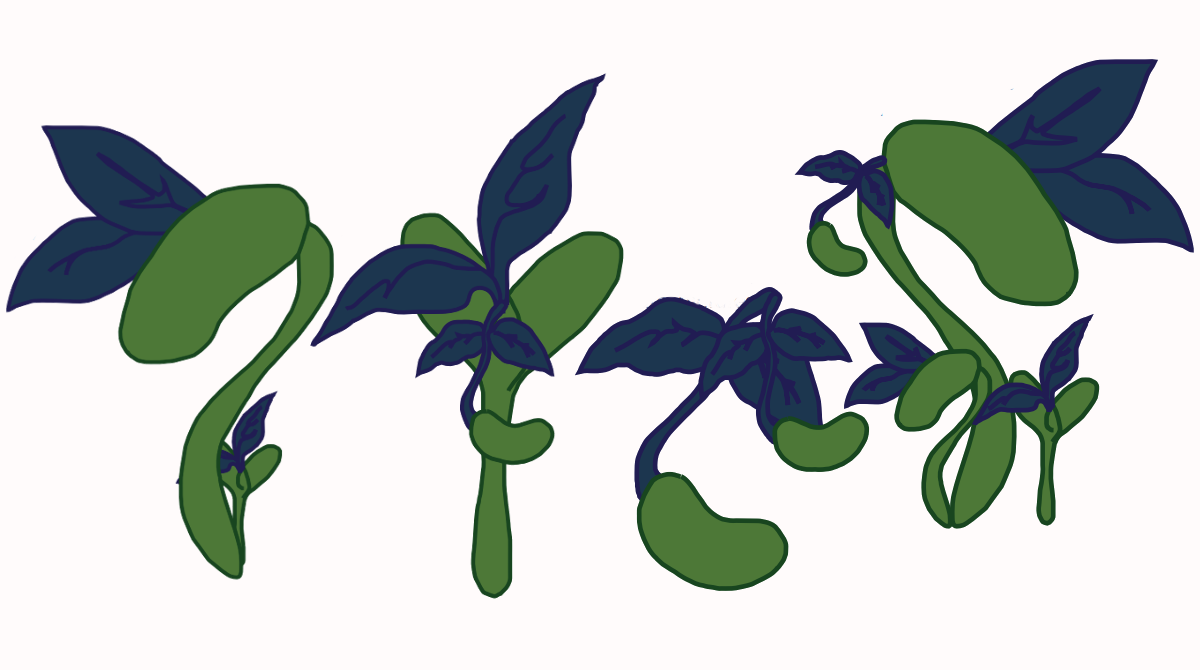
Illustration by Chloe Davison
This piece was originally published in ‘Memento Mori’, Bossy’s 2021 print edition.
It’s yet another COVID-19 lockdown. I find myself lying on the bathroom floor as boredom and insanity bleed into one another. Disgusting, I know, but the cold tiles have a way of shocking life back into you at 2 in the morning. Today, I’ve done nothing but sit on my couch with Friends playing in the background as I fell in and out of slumber. In my house, Netflix is used as background noise to make up for the heavy silence lingering in the air.
Right now, I’m thinking about dried butter beans. Everyone grew them in primary school. Remember the plastic cups stuffed with cotton balls; a single bean nestled in the middle? The teacher had to keep replacing my butter beans because I kept eating them. I was a very hungry child. My class grew them in third grade. Then in fifth grade. Then again in eighth grade. Every time those green sprouts pushed their way out of the bean, I was just as excited as the last.
I can hear my dad pacing around the house. Why is he still awake at this hour? In family photos leading up to my early teens, we look like the standard, happy father-daughter combo. There are pictures of him piggybacking me, of us posing in front of important monuments with the classic Asian V-sign pose. My last good memory of us is conjured in slow motion like this: we’re standing in the middle of a field. He lifts me up and throws me into the air. An excited scream escapes my throat as he catches me. But I know it’s not true. Nostalgia morphs memories the way dripping water carves stone.
Things changed somewhere along the line. The conflicting values of Western individualism and filial piety estranged us so insidiously that it felt like we’d been strangers our whole life. I wish I could create a telescope that’s trained on the past. Each time I begin to doubt if what I remember is true, or if a memory happened at all, my dad and I could stand side by side and look into the telescope together. If we can find out what went wrong, maybe we could go back in time to mend it.
It’s 2:30am now. The bathroom tiles have adjusted to my body heat. My phone buzzes next to me.
Teyana Thompson: So did your parents get that divorce yet?
I delete the notification.
For many Chinese children, the signpost of adulthood is realising that your parents are actually unhappy together. In memory, my parents loved each other. They were the stock photo couple smiling happily into the camera. But photos are posed, a fraction of a second pretending to be reality. Now, my mum points at the photos and tells me the truth behind them. “Your dad and I had a massive argument a minute after this photo was taken,” or, “This photo was from when we didn’t have a single cent left.” A funhouse mirror distorts your perception until you can no longer distinguish fact from fiction. Adulthood is realising that this perverted reflection had been the truth all along.
I close my eyes. I wonder how Ryder’s parents are. Do they still love each other? Ryder was my childhood best friend. In second grade, we would spend our afternoons at the park racing each other down the slide. In the early hours of the morning, when I’m deluded by fatigue, the heat light of the bathroom warms the memory. Ryder and I were friends at a time when we had just begun to understand the physical differences between boys and girls. Curious like all children are, one day after our swimming lesson, we stood in the corner of the kid pool and showed each other. A giggle escapes my lips. Though embarrassing, it’s sweet to think about how naive and clueless we once were.
The following winter, we both moved away. I never saw him again. The more I recall these memories, the more they change. Slowly, the embellished details overshadow the person I’m trying to remember. The setting always survives in fine detail: the smell of chlorine at the pool, the dark tarmac of the road leading to his house, the eucalyptus trees dotting that park we played at. But the finest detail, his face, is long gone. I turn to look at him, but a faceless entity stares back. Some neuroscientists say that the safest memories are the ones we can’t remember. Immune to reconstruction, these memories are the closest replica of actual events.
My stomach rumbles. Growing butter beans in cotton was kind of disorientating. It felt almost unnatural to witness the grotesque stems intertwining together through the cotton. In the wild, dirt hides the matted roots; bugs and spiders infest plants but are hidden by the leaves. Even snakes hide in the bushes. But clear plastic reveals all that is ugly.
In eighth grade, a friend made a passing comment about my nose being big. From that day on, I scrutinized how my nose appeared from each angle. I memorised which facial expressions drew attention to it and which ones made it appear slimmer. I made sure to cover my face whenever I laughed. It seems like for many girls, hypervigilance and self-consciousness are a package deal with adolescence.
I hated my nose, but Andre didn’t. He said it was cute and that it was his favourite thing about my face. Andre was my first boyfriend. We met in seventh grade and easily became friends because we shared all of our classes together. Like many things, you only learn to appreciate it in retrospect. Both of us loved canned tuna, so Andre would bring a can of tuna to school every day for us to share. Not wanting to be teased by our friends, he’d hold my hand underneath the table as we played UNO. At that time, my biggest insecurity was my hyperhidrosis. Every time someone touches my hand, my palms sweat uncontrollably. It’s a physiological defence mechanism from having emotionally distant parents who never held me as a child. But Andre didn’t care. He’d tell me to hold my palms out, pretending to show me a magic trick, but then sneakily hold my hand. It’s cheesy, but your first love truly is unforgettable. You approach it with an innocence and openness that you can never regain once you experience heartbreak. Though I haven’t seen Andre in years now, I still keep the love letters he wrote me in a box underneath my bed.
A soft knock disturbs the silence. My dad whispers my name, asking me if I’m alright. I tell him I’ll be out in a minute. It’s almost 3am now. I feel exhausted, but sleep will only lead to tomorrow and I already know exactly how tomorrow will unfold. This lockdown is never-ending. My brain itches with boredom as I feel myself teetering off the edge of sanity. I’m begging for it to be over but I know that once this Groundhog Day is over, another awaits. Childhood boredom is one full of dreams, a projection into another reality. Adult boredom is one of repetition, where we no longer expect any surprises.
And so I lay here, unmoving with my eyes half closed. The world seems to be completely still, like a Sunday afternoon. The yellow light hits the ceiling perfectly and suddenly I am a child again. It’s midday and I’m pretending to be asleep. The sunlight filters in through the curtains, illuminating specks of dust that dance around in the air. In the living room, my mum laughs at something on the TV. It’s summer. A mosquito is buzzing around my head. Ryder will be coming over soon.


Leave a Reply