
Written by Keighli O’Brien
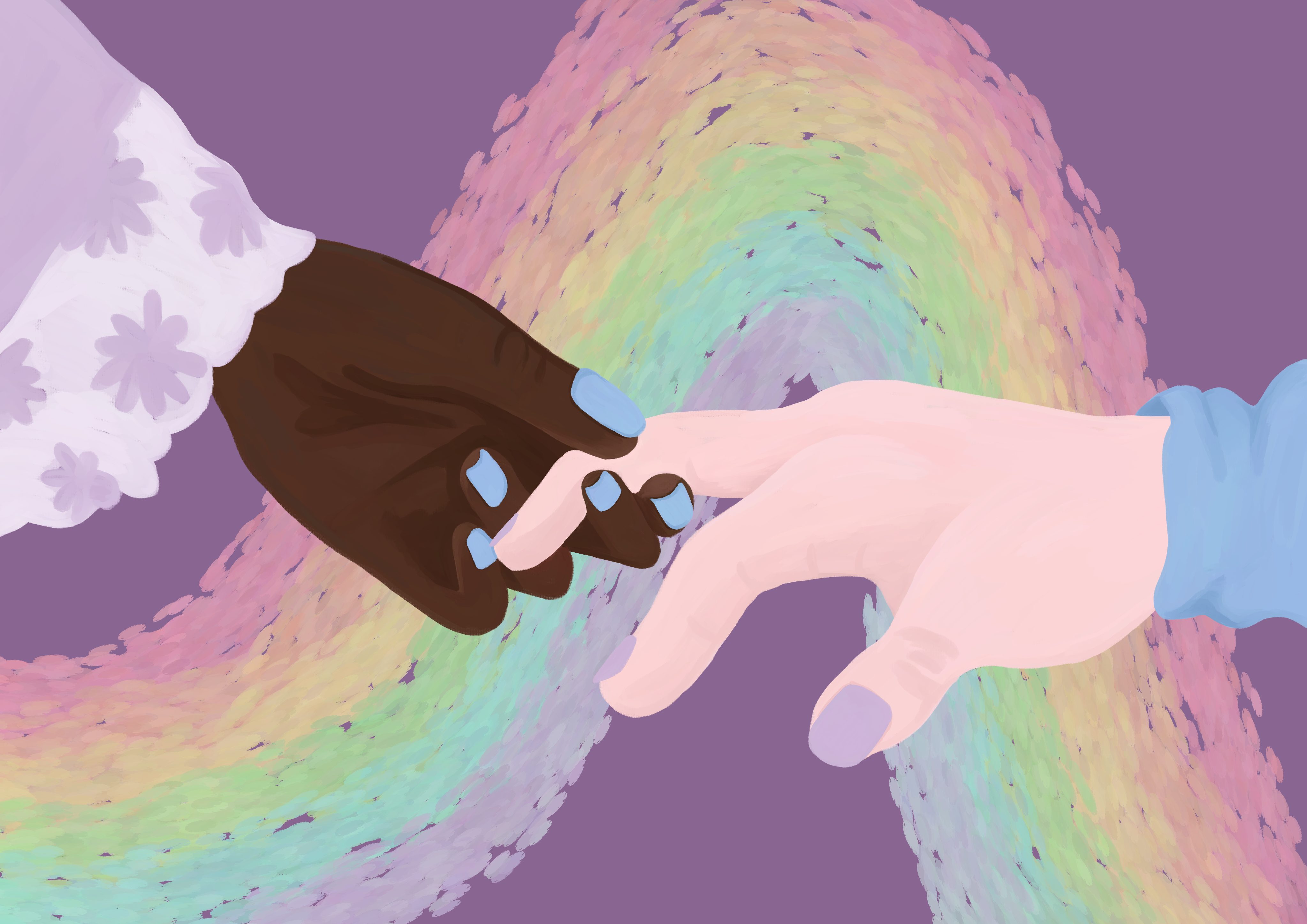
Illustration by Faith Freshwater
CW: Discussion of biphobia, colonisation, homophobia, misgendering and racism.
This piece was originally published in ‘Vestige’, Bossy’s 2023 print edition. Interview responses have been edited for length and clarity.
Danielle Scrimshaw is a historian, writer, and all-around incredible human being. To list some of her achievements—her 2019 essay Be Gay, Do Crime: Or, the Ballad of Catherine and Ellen was shortlisted for the Deakin University Nonfiction Prize, her thesis on queer women was commended by the Australian Queer Archives, she was a finalist for Forty South Magazine’s Van Diemen History Prize 2020-21. She has been published in Voiceworks, Overlands, Scum Mag, and Archer Magazine. I was fortunate enough to speak to Danielle about her first book: She and Her Pretty Friend: The Hidden History of Australian Women who Love Women. Her book powerfully examines the queer history in Australia—from hundreds of years ago to today. Each chapter focuses on a different female-identifying or non-binary individual’s journey—exploring gaps in Australia’s queer history. She describes her book as a “celebration of the hidden history of Australian women who love women”, which perfectly explains this enlightening piece.
I must admit, on the morning of our interview, I anxiously sat at the computer waiting for the Zoom meeting to start. What can I say? I am a big fan! I had read the whole book in one sitting and was in awe at the amount of research and emotional discovery that went into writing it. But enough about me.
Danielle joined the meeting and warmly greeted me, which prompted me to excitedly ask her how she developed the idea for this book.
Danielle thoughtfully replied, “Well, the book began as an honours thesis while I was studying at Deakin University, so I was trying to find a topic I could write about for a year. I had just come out as queer, so I was researching queerness as a concept. I found that where women’s queer history is concerned, there was not much out there, with most of the published material dating back to the early 2000s. I found a gap and decided to write my thesis about the erased history of queer women in Australia. I researched so many women but could not include them in my thesis due to the word limit, and that’s where this book idea eventuated”.
Danielle’s book includes many case studies of women and their relationships with other women, drawing on her experiences as a queer woman. Each chapter has a new journey—from convict women in Tasmania, to pastoralists in regional Victoria, to the first female doctor in Brisbane and the owners of Melbourne’s first female-only gym. When I asked Danielle whose story resonated with her the most, she proudly responded with the names of Katie Lush and Lesbia Harford. Lesbia Harford was an Australian poet who wrote love poetry for her friend and philosophy tutor, Katie Lush. Some historians, such as Danielle, speculate the possibility of a queer relationship between the two.
Danielle explains that “[she] was going through [her] own queer awakening when researching them, which led [her] to put [herself] in the narrative a bit heavily.” However, she further explained her attachment to women in the 70s and 80s Liberation Movement. “I felt like I was reading about old friends. I found that these women were so brave, and reading about their public rallies, demonstrations, and interviews was inspiring. I developed a real emotional connection to them.”
When speaking about Lesbia Harford and Katie Lush, I was prompted to ask Danielle about the legitimacy of speculation when dealing with queer history. “It is difficult,” she stated. “I allowed for speculation with some of these women as it is not productive to put them in that heterosexual category because no other information is available. We know these women had female partners whom they lived with and showed commitment and devotion. That is the basis of a relationship. There is more than one way to be queer. Even if a couple lived together but never had a physically intimate relationship, there can be that level of love and attachment. Speculation is valid if there is solid groundwork. However, women in the 1850s and 1900s had limited information and knowledge, so we do not know if they would have identified a certain way if presented with labels”.
When we spoke of Danielle’s queer journey, she explained that uncovering these women’s stories helped empower her sexuality. “I came out in 2017, a year before I started researching for my thesis. Around that time, I was going through many “firsts”—my first date, kiss, and relationship. Those experiences ran parallel to the research that I was doing, and the two went hand in hand.”
I asked Danielle if a particular woman’s story surprised her, to which she named Val Eastwood, the owner of a Melbourne café in the 1950s for queer people. “She seemed so unbothered by her sexuality. She was comfortable being a lesbian, even in the late 1940s and early 50s. It was an intense thing to come out as queer during that time. However, Val Eastwood was so open to her queerness and opened her café to welcome queer people – a bold and admirable act”. When speaking of lesbianism in the 20th century, Danielle stated, “These women were assumed to be sinful or mentally ill. There had to be something wrong with them.”
As Danielle has been researching and writing for the past five years, her own knowledge of gender, sexuality and queerness evolved. Danielle exclaimed, “The way we discuss gender and sexuality is changing all the time. We have extensive knowledge and labels, and now we are faced with applying this knowledge to people who lived 100 years ago, which is very difficult. We need to be open about gender and sexuality and not categorise them so much. We can see both as a spectrum, with gender being more fluid and queerness as a changeable identity. There is more than one way to be queer and more than one way to be transgender.” Encompassed in this is the way Australian history is taught as a whole. “The way history is taught is very white, cis-male focused. I learned about the Gold Rush, Gallipoli, and the Eureka Stockade when I attended school. There was not much focus on women’s history or Indigenous Australian culture. The schooling curriculum needs restructuring; part of this is how we tell queer history and talk about our national identity”.When asked about decolonising queer history, Danielle says, “We should carry the burden as White people. We need to include First Nations people in that conversation, but White people must listen, learn, and actively create more space for those voices”.
Concluding the interview, Danielle spoke to me about the purpose of her book and research.
“I wanted to make people excited about history and for people to approach queer history with an open mind,” she said. “I want people to reflect on their queer stories to build upon this research. Much research still needs to be done, as this is just one contribution to Australia’s queer history. I would love people to become more involved and feel validated by the past. So often we are told that queerness is a new thing, but it is not true, and we need to discuss that more”.
She and Her Pretty Friend: The Hidden History of Australian Women who Love Women is out now and can be purchased in stores and online.




Leave a Reply