
Article written by Maddie Chia
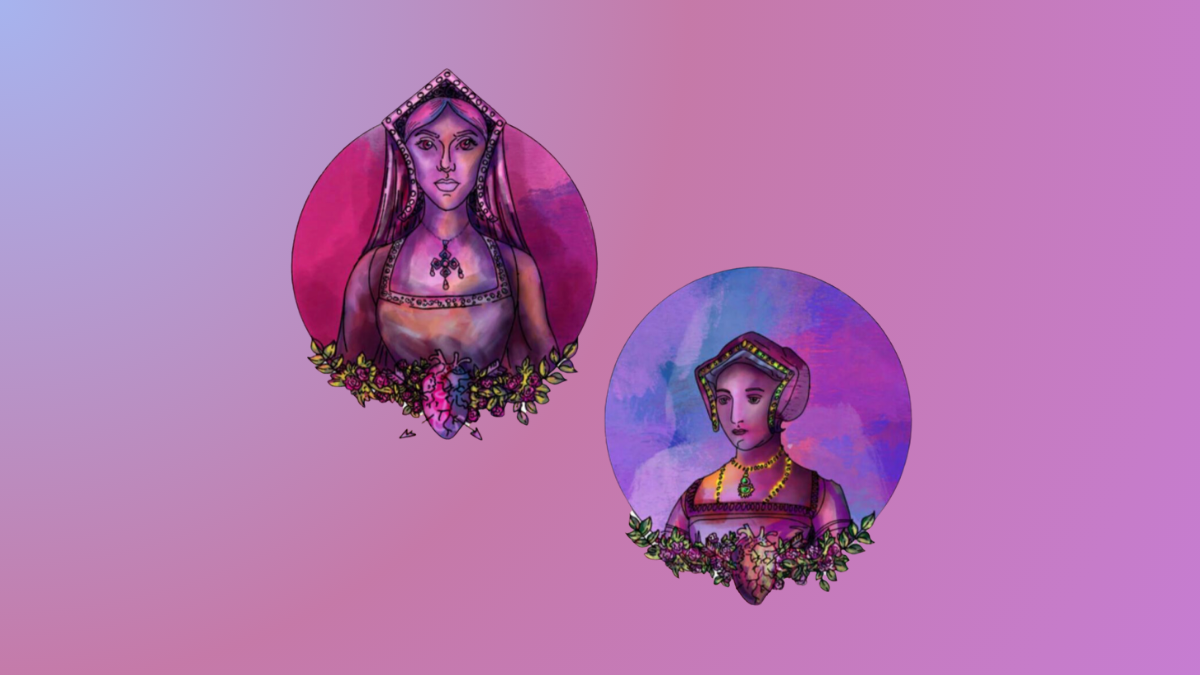
Illustration by Navita Wijerante
Content Warning: Mention of sexual assault, trauma, and child sexual abuse.
This piece was originally published in ‘Chimera’, Bossy’s 2022 print edition.
_____________________________________________________________________
Divorced, beheaded, died; divorced, beheaded, survived.
Tudor history has been a big part of my personal coming-of-age story. Growing up, I was always a huge history nerd; so were most of my friends. The culmination of my Tudor obsession was asking my mother if my sweet 16th could be Henry VIII and his six wives themed. I think she was just glad I’d grown out of my emo phase from the previous year. This fascination with Tudor history began when I went to London at 13—I own every piece of Henry VIII merchandise sold at the gift shop. Scratch-and-sniff books, Christmas tree decorations, with my foam mask of his face being my favourite possession. I own three of these, just in case I misplace one.
I grew out of this phase, and mostly forgot about it when I went to university. All the merchandise and the meme wall I created in my room were pushed to the back of my wardrobe. It wasn’t until last year, when I was driving with my best friend and she played the soundtrack to Six, that I was once again hooked on Tudor history—this time, through a different lens: the wives and their stories.
As I began listening to the soundtrack and researched the musical’s origins, I started to question my childhood fascination half a decade on. When we learn about Tudor history, we are taught about Henry VIII and “his six wives”. It’s never phrased as Catherine of Aragon, Anne Boleyn, Jane Seymour, Anne of Cleves, Katherine Howard, Catherine Parr, and their husband Henry VIII. These women are known merely because of the man they married, not for what they achieved. Six is a powerful retelling of their lives through a feminist lens, giving a voice to women who were told to stay silent and endure traumatic behaviour from men. It explores themes of empowerment, autonomy, and exploitation, drawing parallels between the women’s stories and the modern woman’s experience. It is also the only musical to date that features a cast made up entirely of women. Each wife has her own solo about her life and experiences with Henry VIII, with the queens’ characterisation being inspired by modern pop singers.
Six is framed as a pop concert and mini competition between the ex-wives to see who endured the most trauma while married. By initially imagining rivalry and hatred between the wives, the musical evokes the common trope of pitting women against each other when a common man is involved, with the writers drawing ironic comparisons to how women in history are depicted as accessories, vying for attention through their association with men. This irony is not only tied to historical objectification, but also references the way the media still actively encourages slut shaming and competition between women. While the queens later address how their musical’s competitive premise was a symptom of patriarchal pressure, the irony is not overly explicit across the show, and is sometimes in danger of being lost in translation, especially when lyrics like “I think we can all agree I’m a ten amongst these threes” are prevalent throughout and are played for laughs, not leaving the audience much time for any serious reflection. Nevertheless, their rivalry implicitly adds nuance to Six’s portrayal of complex and imperfect women in the spotlight, specifically challenging the ingrained biases we often hold about other women. The musical ends with the queens uniting and vowing to rewrite their own stories, changing each from “his-story” to “her-story”. Its final song is a reimagination of their lives if they had said no to Henry VIII, about living for themselves rather than a man.
For me, the most intriguing aspect of the musical is the story of Katherine Howard. Katherine Howard’s persona is largely based on Ariana Grande, Miley Cyrus, and Britney Spears—singers who were all sexualised as children by the media, similarly to Katherine. Her comparatively revealing outfit is symbolic of the scrutiny women and young girls continue to face after having dressed in a way that is deemed “inappropriate” or “highly provocative”, an allusion to how the men in Katherine’s life justified abusing her based on her appearance. Six was written in 2017 in the midst of the rising #MeToo movement, and Katherine’s story highlights the continued importance of raising awareness about the historic abuse women have been subjected to that is unfortunately still commonplace. Her solo starts off with a cocky and sexual tone, as she states “ever since I was a child, I’d make the boys go wild”; however, as the song progresses she becomes extremely agitated and frantic as she tries to assure herself that “I’m sure this time is different” after each man exploits her. Katherine Howard was around 17 years old when she married Henry VIII, who was 49 years old—32 years her senior. This pattern of neglect, abuse, and emotional trauma was present in all of Katherine’s significant relationships with men. She was courted by her music teacher Henry Mannock when she was no more than 13 years old, and by Francis Dereham at 15. There is no real consensus on when Katherine was born, which means she may have been even younger.
Katherine’s song really resonated with me as a survivor. To this day, women are catcalled on the street, boys take advantage of us, and child pornography unfortunately retains a large consumer base. The other wives berate Katherine Howard for being too sexual, which again parallels with the modern experience of women tearing other women down for how they appear. Some go as far as calling other women names, such as whore or slut, which perpetuates patriarchal ideology and devalues bodily autonomy. The repudiation of women’s and young girls’ autonomy has happened constantly throughout history, with so many key historical figures being married off extremely young. While this was partly due to historical social constructs, examining this from a modern lens, it is exploitation. Katherine Howard was beheaded in 1542, likely younger than 18 years old. She was a child. History has been so fixated on Henry VIII that we don’t even know how old Katherine was when he had her executed. Her song in Six forces us to confront the reality of the exploitation and perception of women as commodities, both in history and today.
Six gives back autonomy to these incredible women and confirms the gravity of everything they went through. It is the perfect blend of pop music, theatrical retelling, and Tudor history. It is about questioning what we have been taught in mainstream history and the glorification of toxic male historical figures. In itself, it is an extremely creative production that exposes the alarming toxicity of Tudor patriarchal structures, giving these women the space to tell their own unique stories of love, violence, and trauma. I hope that Six’s legacy is to spur a trend of normalising women’s voices in history studies and acknowledging their importance in pivoting major historical events.
My relationship with Henry VIII and Tudor history will always form a large part of my identity and be a key interest of mine. However, I’ve come to realise that maybe the reason why I latched myself onto Henry VIII as a historical personality was because of my affinity for toxic men and my past traumatic experiences. Six allowed me to understand and unpack issues of misogyny in history that had never previously crossed my mind. I am no longer ashamed of my obsession with Henry VIII, but proud of my newfound knowledge about the period’s amazing queens and what they had to overcome.




Leave a Reply