
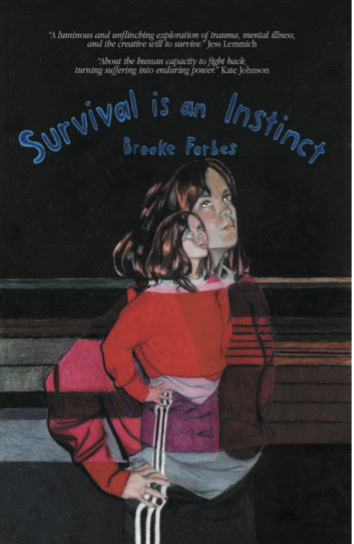
Brooke Forbes (she/her) is a lawyer from Newcastle, NSW, now practising in Alice Springs, NT. She sat down for an interview with Bossy before the publication of her first book ‘Survival is an Instinct’, a series of personal essays intertwined with ten creative stories rooted in her mental health journey with schizophrenia, experiences with sexual violence, and the role creativity and writing has played throughout hospitalisation and healing from trauma. ‘Survival is an Instinct’ touches on themes such as the willful ignorance toward gendered and domestic violence in Australia, moral complicity, and life’s unpredictabilities.
Brooke Forbes’ book can be found at:

This interview has been edited for length and clarity.
- Could you share a bit about your background and what led you to write Survival is an Instinct?
My first degree was in journalism and creative writing. I’ve always wanted to write a book, and I talk about my relationship with writing in Survival is an Instinct as being held in some of my earliest memories. I always wanted to be a journalist or writer, but later in life went into law. I grew up in a middle-class family in suburban Newcastle, a beautiful beachside suburb called Redhead. I have many fond memories of my childhood and accessed a decent public school education in Newcastle.
Survival is an Instinct wouldn’t exist without the constant prompting of my former mental health NDIS support work client Nathan Bell. Nathan is a prolific writer who sells his works in a pop-up stall across the state, but most commonly on Beaumont St, Newcastle. Nathan has also been diagnosed with schizophrenia and suffered many episodes of psychosis, which he writes about. I mentored Nate during this first book, Kings of the New Age, which is a post-apocalyptic epic novel set in Newcastle. We had a lot of fun mapping out the real-life locations and references to Newcastle locations when we worked on the book. What I really admired about Nate was his ability to use creativity to heal and carve a way forward. So, after several promptings to “do something with my short stories,” Survival is an Instinct was born.
I decided to intertwine these with a personal essay on the theme of survival, because I’ve often used writing as a way of healing and creativity engaging with trauma. A lot of the personal essay just ‘came out of me’. I didn’t have a set intention on what I wanted to achieve but rather would wake up sometime early and let the words flow.
2. What encouraged you to publish this story publicly?
I was really prompted by Nathan… I understand the themes I approach hold a lot of stigma and can be triggering for some, however I am a believer that silence doesn’t perpetuate growth and healing as much as expression does; so this is both a radical act of self-healing and a radical act of advocacy for other survivors. I’m still coming to terms with what I have made public in this book. I can only hope it is received in a way that helps others. I have also been encouraged by a small group of people who previewed the work, predominantly friends and family, who have helped me realise this is an important story to be told.
3. What comes first in your writing process: the desire to tell the story, or the story/idea itself?
It can be either, and often these two aspects are intertwined. For example, Her Lucid Mind was written initially when I was in recovery from psychosis – and I only finished it recently. The idea was to artistically depict that fracturing of your mind in psychosis but also the way your mind talks to you. There were clear narratives in my psychosis – it’s not all madness and an inability to comprehend reality. In fact, you create a new reality. So the idea to depict psychosis technically came first, and then I created a narrative around that.
I suppose a lot of my stories happen in that fashion – I have a feeling or idea I want to convey and then build a narrative around it. Drifted, for example, I had no idea what was going to happen until I wrote it. Killing for Love however had a stronger sense of story when writing it, and I remember writing the end before fleshing out the middle sections.
4. How much did the story change between when you began writing and its publication, or revisiting them in a different frame of mind?
I tried not to change them because I wanted them to be a reflection on my state of mind at that time – therefore while I edited the stories at the time, I have done little editing post-production for the book. There are some exceptions: Her Lucid Mind was written half in recovery and finished quite recently.
5. You structure your book as a blend of personal essays and short stories. How did you land on that format, and what does it allow you to explore that a traditional memoir might not?
I think I started writing Survival is an Instinct in the notes section of my phone, late at night or early morning. It started with A Space for Justice and was heavily influenced by my therapy sessions at the time as well as general thoughts on how I can achieve justice when the justice system didn’t really want to engage with me. It was a theoretical question for me but also a very personal one, and one that bled into my advocacy for other survivors of sexual assault. Not everyone gets a sense of justice from the system. In fact, only 13% of sexual assaults are reported at all. So the question was ‘What of personal justice? Where do you find it?’ And I landed on the concept of story-telling and creativity, and how you can reclaim your story through the seemingly simple act of telling it.
I wrote the sections A Space for Justice and What I’ve Learnt About Survival together and started to map out a book. However, when I landed on White Coasts and Shiny White Floors, I couldn’t move forward without describing psychosis in a creative way – these overlapping thoughts and perspectives and narratives that occur – so I decided to include a creative piece I had written previously instead of maintaining a non-fiction voice.
6. How did writing these stories contribute to your healing or processing of trauma? Was there a particular short story that felt the most difficult or cathartic to write?
Writing has been essential to my understanding of what was happening to me – but also maintaining a sense of self during recovery. I lost my first career due to sexual assault and subsequent corporate bullying across different companies by people I should have been able to trust – this really knocked around my sense of self and self esteem – not to mention then falling into psychosis which was extremely complex and confusing. I was living with my parents, I had none to very little savings, I had no back up career path that could replace the momentum I had built in the tech sector – so I was really dependent on this primal instinct to write and express myself.
Killing for Love was a lot of fun to write – it’s one of my favourite short stories and is based on some of my experiences of the male gaze and approaches towards male violence for women when they date women. I took homophobia to an extreme in the piece – but it’s also something I’ve experienced first hand – so in that respect it was very cathartic to write.
Her Lucid Mind was also very cathartic – trying to encapsulate the narratives within psychosis and different layers of perception. My psychosis was at times on a manic high where I had delusions of grandeur – like training to become the next Prime Minister, or going shopping for a collection of suit coats to dress for becoming the next Prime Minister – and at other times my psychosis was really dark and terrifying. I had all kinds of horrible thoughts that I couldn’t control. So I’m not even sure I was able to encapsulate the realities of psychosis in the piece – but I have given it a go.
7. You mentioned creativity and writing was a “therapeutic measure” in your recovery. In what ways did story-telling, or any other creative outlet, help you survive and rebuild?
During this journey I was stripped bare of a lot of identity. I had lost my career path, I had lost money, I had lost independence. [The] concept of writing to reclaim my story really resonated with me – in many ways it’s a primal instinct, the need and want to communicate with people and find a community. Writing was integral to that. I also reflect on my time as a Peer Support Creative Writing Teacher, teaching students like Nathan Bell, as a way of understanding the powers of creativity to heal. Survival is linked to communication on this very primal level – the pack outlives the individual – so finding ways to connect, express and ultimately heal were really important parts of my recovery – as was articulating my experiences, so I could move forward through the ebbs and flows of recovery.
8. Were there any books, writers or artists who influenced you or kept you going through recovery? Any whose work you return to?
I’m heavily influenced by Margaret Atwood and Haruki Murakami as my two favourite authors… This is a bit of a confession but I actually have tattoos on my back inspired by both of those authors.
However, in recovery I read Elyn R Saks’ The Centre Cannot Hold, which is a brilliant memoir of living with schizophrenia. I was actually given the name of this book on a piece of paper in hospital by a very considerate psychiatrist. I don’t remember her name, I passed through a lot of doctors during my hospital visits, but this gesture was really important to me. It gave me a light at the end of the tunnel, in sharing lived experience but also demonstrating normal success. I think this book is one of the reasons why I chose to study law after two episodes of psychosis. Elyn R Saks describes severe episodes of psychosis in her works but maintains an esteemed level of success in law and psychology. She is an American legal scholar who is an associate dean and Orrin B. Evans Professor of Law, Psychology, and Psychiatry and the Behavioral Sciences at the University of Southern California Gould Law School, an expert in mental health law, and a MacArthur Foundation Fellowship winner. I admire her greatly – and related deeply to her memoir.
9. Your pivot into law is fascinating, especially given the emotional depth of your writing and, more generally, your work as a creative writer. How do you balance these seemingly opposing parts – the rational practice and writing of law, and the raw, intuitive process of creativity? Do those parts ever conflict or inform each other in surprising ways?
I believe the two skillsets intertwine at times – especially writing skills. You’re using your ability to interview and tell a factual account of a client when you are writing a first-person affidavit on their behalf – which greatly relates to my journalism roots. However the more creative expressions and experimentation with creative style falls squarely in the creative sphere of my identity.
I suppose I try to keep both active. Legal reasoning, development and research which informs my profession, and the personal expression involved in creative pursuits. I believe you don’t need to choose one over the other in your identity, and creative outlets have always been important to me.
However, there are times when I need to ‘switch’ from a rational, objective stand point when creating arguments in a court case to creative freefall in writing. I often do these two things separately and they don’t seem to compete – although finding time for both is a challenge! At the moment creative writing is a hobby of such, but it’s something I return to constantly.
10. How did you navigate healing while seeking justice or accountability in systems that you, yourself, said didn’t feel particularly supported by and that survivors often struggle to navigate?
I believe my work as a lawyer has informed Survival is an Instinct – especially around concepts of justice and what personal justice means. In my work, I see many survivors not obtain traditional justice through the court systems. These stories amalgamated in my mind, and while I don’t reflect too heavily on my work for privacy reasons in the book, I was influenced by the collective ‘co-consciousness’ of survivors.
It’s really hard to navigate the justice system that doesn’t always take into account the perspective of the victim… and it also doesn’t take into account that the victim needs to heal at the same time. Given the two options, I’d always advocate for healing first, because that’s the most important part of recovery. However, this tactic may cut off many avenues for justice in a traditional sense. The police wanted to know why I didn’t report earlier, the civil system [also] had a time limit barrier.
I also wrote about the threat of defamation in the book, which still prevents survivors from speaking out about their experiences in detail. The onus is on the defendant to defend themselves from litigation. In these circumstances, if the perpetrator tries to sue for defamation – which is really an unfair trick of justice – demanding the survivor to litigate that defence is, of course, the truth, but establishing legal representation is a costly exercise only available to some.
I chose to de-identify my story to escape defamation claims for this reason. But the justice system re-traumatises victims at every step, which it doesn’t align with healing, so the question of healing or justice is extremely personal and tricky. No one can make that decision for you, but it’s important to go into it eyes wide open.
10. There’s still a lot of misunderstanding and stigmatisation around schizophrenia, especially for women. What do you wish people better understood about living with the condition?
While schizophrenia is a chronic condition – meaning there is no cure in particular – you can live a very normal life under medical intervention and guidance. Each time you fall into psychosis it’s not like a little episode and then you snap back to normal – each time takes up a lot of energy and recovery time.
While it’s important to remember people living with schizophrenia can live absolutely normal lives, with normal hobbies and connections – and even high achievements like Elyn R. Saks – it’s also important to note that personal responsibility and community help are crucial in maintaining your recovery. Medical upkeep and staying on top of any symptoms that still arise. I have had trouble with nightmares which is something I’m working through with a combination of therapies and medications.
Most importantly, the reception of people living with the condition, who may be in different stages of the illness, needs more awareness. There’s a lot of negative media about people with schizophrenia committing crime – I refer to the Bondi attacker in my book as an example of this. However people with complex mental illnesses are more likely to be a victim of crime than the perpetrator.
I especially feel for people who are disconnected from services and community in their symptoms and recovery. There’s a gap between socio-economically privileged and those less privileged with outcomes on recovery – and that’s an issue I’d like to help address through community, volunteer, and awareness work.
11. What would you say to others navigating trauma or mental illness who feel disconnected from their creativity or their voice?
I would say you find meaning in small things. A sketch, a small email written to a friend telling them how you are, a text message even. If you want to build a creative voice the channels are there – however you don’t have to. Some people manage through community connections to volunteer work or peer support work, some people manage through exercise.
I’d also say that connecting to services is vital. I worked for a peer support provider called Rely-Ability as a creative writing teacher – connecting to this outlet really drove my recovery forward and cemented my ideas around creativity and healing. If you are on the NDIS there are providers that can help. Otherwise, community writing groups are a great way to start. Building community around your creativity is an important aspect for me to self-check, make sure I’m relevant and find audiences.
12. What are your hopes for Survival is an Instinct? Who do you hope it reaches, and what impact do you hope it has?
I hope to reach people on every level – those who have experienced mental illness or sexual assault, those who care for someone who has, or know someone, or even people who think they don’t know someone but want to learn about the challenges other people face.
Of course I’d love to help someone survive their own journey and then thrive in recovery.
13. If someone reading your story was in the early stages of recovery from trauma or a mental health crisis, what messages would you most want to share with them?
I think most importantly you’re not alone. You have a voice. And you can survive this. There will be days where it’s all too overwhelming but the clarity and strength you can rebuild on the other side if worth it. Life is beautiful, and that beauty hasn’t been taken away from you. It can be found in the smallest of things, and light always shines brighter than darkness. But I don’t want to sugar coat it either – recovery is hard. It’s just about taking one step at a time, and one day at a time. I have tried not to write this book from the angle of “how to survive trauma” because every story is unique and needs a unique approach.
But universally, I believe life does allow you to grow through the darkness and reclaim your future. There is hope and connection and community; and when these things combine you can rebuild an inner strength that allows you to overcome your obstacles.



Leave a Reply