
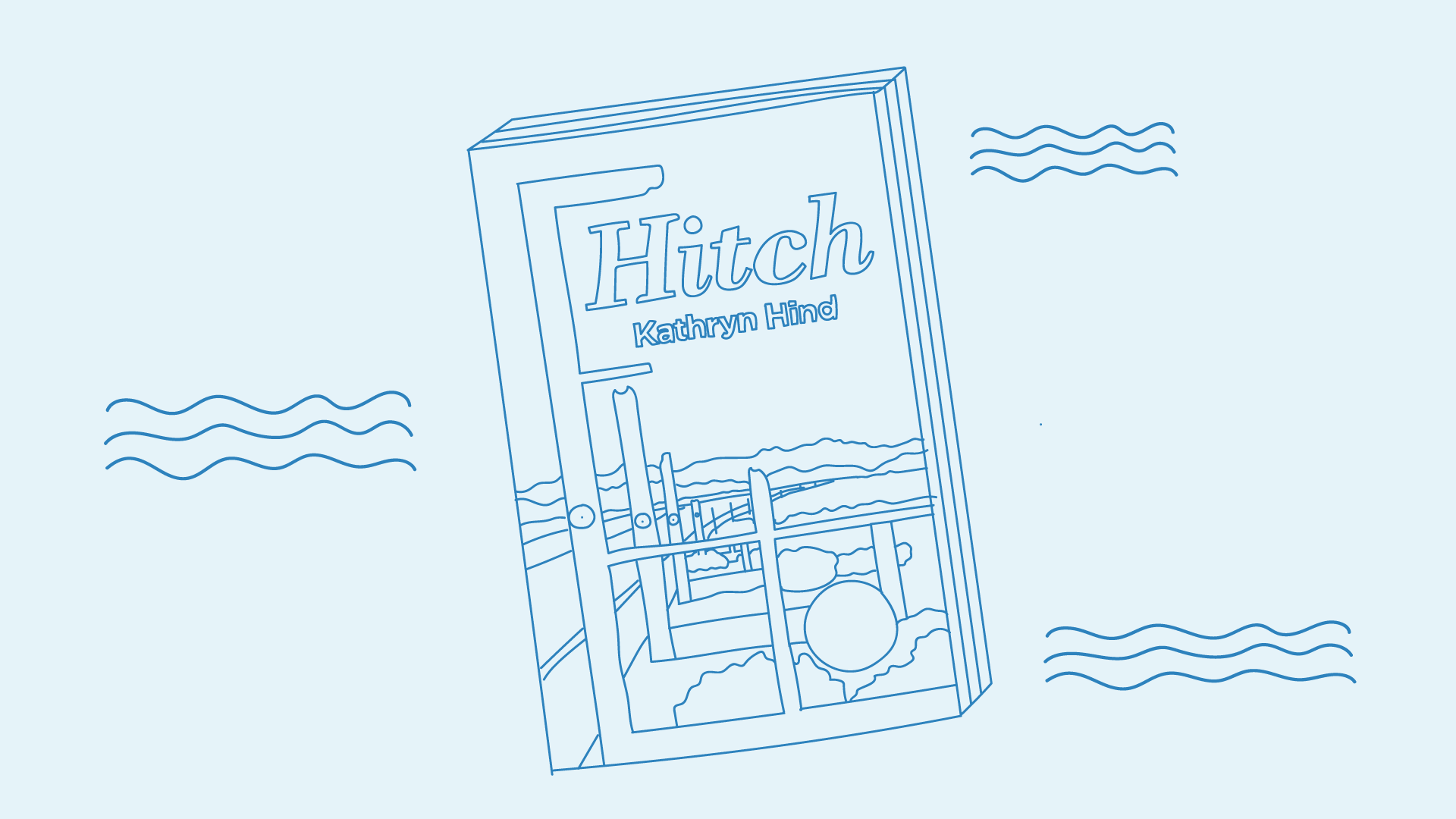
Interview by Eilis Fitt
Illustration by Juliette Baxter
This piece was originally published in ‘Turning the Tide’, Bossy’s 2019 print edition.
Kathryn Hind is a Canberra-born writer and winner of the inaugural Penguin Literary Prize for her first novel, Hitch (published June 2019). Hitch is the story of Amelia, a twenty-something woman hitchhiking across Australia with her dog Lucy. It explores themes of consent, agency and grief with empathy and raw emotion.
An excerpt from the beginning of Hitch was published in an earlier edition of Bossy and now that the book has been officially released, Bossy sat down with Kathryn to find out more about how and why she writes.
Tell us about the writing process. What came first – the story or the intention to write one?
The intention was definitely there first. I had been working a comfortable job in communications and reached a crossroads: I could continue working that job, or I could have a proper shot at what I was passionate about: reading and writing fiction. I was accepted onto a Master’s program in the UK and in the first weeks there, I began Hitch.
How did you begin? Did you have a plan for the whole story before you started?
A scene appeared in my mind, a young woman, Amelia, by the side of the road with her dog, thumb out. I didn’t know what was going to happen – who might pull over, the challenges that lay ahead, where she would end up – and neither did she. The image was a strong set up for a story, for a physical and emotional journey. I wrote scene after scene, exploring Amelia’s character, seeing what I could learn about her through the interactions and conflicts she has with the drivers who help her progress along her way.
How much did the story change between when you began writing and its publication?
I spent six-and-a-half years working on Hitch. During that time, some parts of the story underwent huge changes while others are recognisable from the initial draft. I write in an intuitive way rather than to a plan so in the beginning stages, it’s a matter of writing and then looking over what’s there. In revisions, I try to understand what it all means; I work on bringing out the most important truths in ways that feel powerful and that drive the story forward. Through years of repeating this process, I slowly uncovered Amelia’s desires, her fears, her secrets; she is a well-defended woman who doesn’t divulge much of her inner world so hers was a difficult story to tell.
What was the publishing process like?
I signed with a literary agent when I’d completed the first draft and the manuscript was rejected multiple times by publishers in Australia and in the UK. The feedback I received was promising and useful (and I agreed with what editors were saying). I kept returning to Hitch with new ideas about how to improve it so it could reach somewhere in the realms of my aspirations for it. Cut to the inaugural Penguin Literary Prize in 2018: I entered Hitch in the prize and to my absolute delight and surprise, it won.
The publishing process has been a steep learning curve but one that I have enjoyed immensely. Suddenly there’s a team of people championing Hitch and this is in absolute contrast to the solitary environment in which the work was created. That said, the manuscript remained in my control (with astute and much-appreciated input from my editor) until I’d finished the final edits. It’s when the book is available to the public that it officially leaves my hands, and this is something I’m still grappling with. The one manuscript I worked on has multiplied, and readers have the characters I created living in their heads, now; it’s a surreal experience.
Hitch focuses on the story of Amelia, a young woman hitchhiking through the Australian outback by herself. What are your experiences with being a female traveler?
I did some hitchhiking a few years ago. I sometimes did it with another person, sometimes by myself. I have travelled alone extensively. Whether hitchhiking or travelling in more socially acceptable ways, I felt the need to be hyper-vigilant: watching strangers closely, anticipating threat, changing a course of action as nighttime descends, saying no to proposals that may have been harmless and fun because of fear or an invisible pressure to be ‘on-guard’. We see these behaviours in Amelia, too; through her experiences I wanted to highlight the ways in which the world is extra threatening for her because of her aloneness and her past experiences. She is regularly chided for daring to move through the world in the manner of her choosing. Why are people so quick to blame Amelia for asking for trouble rather than focusing on the people perpetuating danger, or on the society that allows this behaviour?
Now that you’ve finished Hitch, you are undertaking a PhD in literature and creative writing. What connections are there between these two projects?
As part of PhD I am examining the passive states of female characters in fiction with the theory that there is much more going on than meets the eye. By looking more closely at these characters, a world of activity and feeling can be revealed despite the dominance of patriarchal systems and behaviours affecting their lives. I wrote Hitch before I began my PhD, but it speaks to this idea. Amelia might be seen as someone relinquishing control over her own life; she is driftwood, taken along by the currents of other people’s lives. And yet, beneath this external story another breathes: Amelia’s story of courage, hope and recovery.
What sorts of books do you enjoy reading?
Anne Enright is one of my favourite authors, particularly her novel The Green Road. I adore All My Puny Sorrows by Miriam Toews. I prefer my fiction to be hard-hitting, and these are, but both have a dark comic edge. Next on my reading list: Too Much Lip by Melissa Lucashenko and Where Reasons End by Yiyun Li.


Leave a Reply